Why Every Horsepower Gets Harder to Buy: The Real Math Behind the Performance Curve
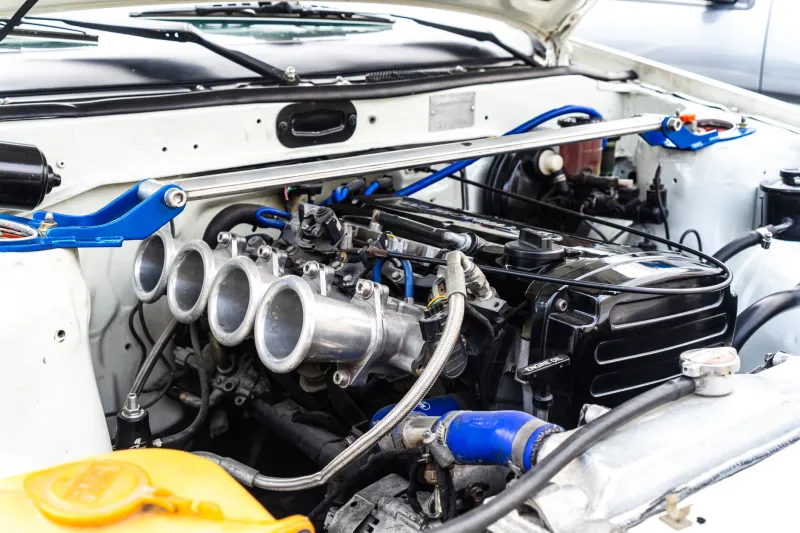
There's a moment every builder knows. You've done the intake, the exhaust, the tune, maybe a set of injectors — and the gains came easy. Fifty horsepower for a couple grand felt like stealing. Then you start chasing the next fifty, and suddenly the invoices look like a different language. Same dyno, same goal, completely different price tag.
This isn't bad luck or getting ripped off. It's physics. And the sooner you understand the shape of the performance curve, the better decisions you'll make with your build budget.
The Low-Hanging Fruit Phase Is Real — But It Has an Expiration Date
Every stock engine rolls off the factory floor with compromises baked in. Manufacturers are balancing emissions compliance, fuel economy ratings, warranty costs, and broad consumer appeal. That means your intake is restrictive by design. Your exhaust is tuned for noise, not flow. Your ECU map is conservative enough to run on whatever octane the guy at the gas station accidentally pumped in.
When you start correcting those compromises — better airflow in, better flow out, a remap that actually uses the engine's real tolerance window — you're not adding performance so much as you're unlocking what was already there. That's why Stage 1 bolt-ons feel so satisfying. You're paying for parts, not miracles.
But that headroom is finite. Once you've uncorked the factory restrictions, the next gain requires actually building more capability into the system. And that's where the cost curve starts bending hard.
Thermal Limits: The Wall You Can't Talk Your Way Around
Heat is the governing factor in almost every high-power build, and it's the reason costs compound so aggressively as you chase bigger numbers. At moderate power levels, your stock cooling infrastructure — the radiator, the oil cooler, the intercooler if you're boosted — can manage the thermal load with modest upgrades. Add a bigger intercooler, maybe a better thermostat, and you're good.
Push past a certain threshold, though, and you're not just upgrading components anymore. You're redesigning heat management as a system. Bigger radiators need more aggressive fans. Higher combustion temps demand better head gaskets, or even a different head altogether. Oil temperatures climb fast enough that you're now looking at a dedicated oil cooler, upgraded lines, and sometimes a full dry-sump conversion if you're serious about track use.
Each of those pieces costs money independently. But the real expense is that they're interdependent — you can't just bolt on one without accounting for how it changes the load on everything around it. That's engineering time, and engineering time doesn't come cheap.
Mechanical Stress Scales Faster Than Power Does
Here's a number that should recalibrate your expectations: the mechanical stress on engine internals doesn't scale linearly with power. It scales exponentially. Going from 250 to 300 horsepower in a well-built motor is a manageable ask for stock rods and pistons. Going from 500 to 550 horsepower in the same block is a completely different conversation.
At higher power levels, cylinder pressure spikes become more violent, rod stretch becomes a real failure mode, and the margin between "running hard" and "grenading" gets razor thin. Forged internals, stronger rod bolts, upgraded main studs — these aren't upsells. They're the price of admission for the next tier. And once you're opening the engine to do that work, you're paying for labor, machine work, balancing, and reassembly on top of the parts themselves.
This is why a 600-horsepower build costs four or five times more than a 400-horsepower build even though the power difference looks modest on paper. The internal work required to survive that output reliably is almost a complete engine rebuild.
Fuel System Scaling: The Part Nobody Budgets For
Injectors are a surprisingly honest indicator of where you are on the performance curve. Stock injectors on most naturally aspirated engines are sized with a safety margin, which means your first round of tuning can squeeze more out of them without issue. Add a mild forced induction setup and you're probably upgrading injectors once, maybe bumping fuel pressure slightly, and calling it done.
But fuel systems don't scale gracefully past a certain point. High-horsepower forced induction builds — especially anything running E85 or high-ethanol blends — demand dramatically higher fuel volume. That means upgraded in-tank pumps, return-style fuel systems on cars that shipped with returnless setups, larger fuel rails, and sometimes dual-pump configurations. E85 specifically requires roughly 30 percent more fuel volume than gasoline for the same power output, which cascades through every component in the fuel system.
None of that is exotic work, but it adds up fast. And if you skip it, you're not just leaving power on the table — you're running lean under boost, which is how engines turn into expensive paperweights.
Software Headroom Runs Out Too
This one surprises a lot of builders who've had success with off-the-shelf tunes. Early in a build, a good calibrator has plenty of room to work. The engine is stock or near-stock, the fuel system is adequate, and optimizing ignition timing and fuel trims produces real, reliable gains.
As you add hardware — bigger turbos, aggressive camshafts, ported heads — the calibration work becomes exponentially more complex. You're no longer adjusting a factory map. You're building a new one from scratch, accounting for changed airflow characteristics, different injector behavior at high duty cycles, and boost curves that the ECU's base tables were never designed to model. Some builds hit the limits of what the factory ECU can even express, which means aftermarket engine management — Haltech, AEM, MoTeC — enters the conversation. That's another $1,500 to $3,000 before you've paid for the calibration time to tune it properly.
Knowing When to Stop Is a Performance Decision
Here's the honest take: for most drivers on most tracks, the diminishing returns curve bends against you well before you think it does. A well-sorted 350-horsepower car with dialed suspension, good tires, and a driver who knows the limits will embarrass a sloppy 600-horsepower build on anything that isn't a straight line.
The performance curve isn't just about money. It's about reliability, drivability, and whether the car you're building actually serves the way you use it. Chasing the next fifty horsepower is fun on paper. But understanding why it costs ten times more — and what you're actually trading for it — is what separates builders who end up with fast, functional cars from the ones who end up with expensive projects that never quite get finished.
Know where you are on the curve. Build with intention. And when the gains stop making sense for your use case, stop chasing and start driving.
That's when the build actually becomes yours.