The Dyno Number Game: What Your Tuner's Horsepower Claim Is Actually Telling You
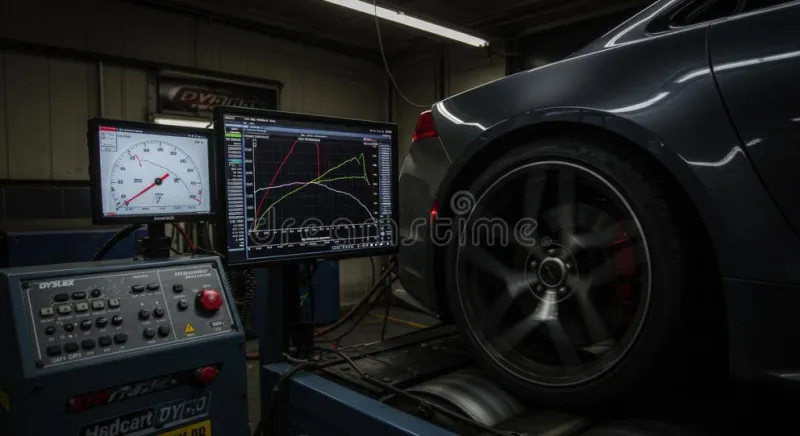
Photo: dynamometer testing sports car horsepower measurement tuning shop, via thumbs.dreamstime.com
There's a ritual in the car community that plays out thousands of times a day across the country. A driver pulls off the dyno rollers, gets handed a printout, and immediately posts the peak number to every forum, Discord server, and Instagram story within reach. The number becomes the car's identity. The number becomes bragging rights.
The number is also, in many cases, a carefully constructed piece of fiction.
That's a strong statement, so let's be precise: dynos don't lie, exactly. But the way dyno numbers are generated, reported, and interpreted is so inconsistent — and so frequently misunderstood — that comparing horsepower figures between different shops, different cars, or even different sessions on the same car can be almost meaningless without context.
If you've ever wondered why your 400-horsepower build doesn't feel like your friend's 400-horsepower build, this is the article you've been waiting for.
The Machine Isn't the Problem. The Variables Are.
A dynamometer measures torque at the wheels or the crankshaft, then calculates horsepower based on RPM. That part is straightforward physics. The chaos enters through everything surrounding that measurement.
Atmospheric conditions alone can swing dyno numbers by 15 to 30 horsepower on the same vehicle in the same session. Temperature, humidity, and barometric pressure all affect air density, which directly affects how much oxygen reaches your combustion chamber. Most modern dynos apply a correction factor — SAE J1349 is the most common standard in the US — to normalize results to a reference atmosphere. But not every shop uses the same correction standard, and some shops use correction factors more aggressively than others.
Run the same car on a cool October morning in Denver versus a humid August afternoon in Houston, and you will get different numbers. Whether those numbers get corrected to the same baseline before they're handed to you depends entirely on the shop.
Hub Dyno vs. Inertia Dyno vs. Load-Bearing Dyno
Not all dynos work the same way, and the type of equipment being used has a significant effect on output figures.
Inertia dynos — the most common type you'll find at tuning shops — measure how quickly a known rotating mass accelerates. They're relatively affordable, widely available, and generally repeatable within a given facility. However, they don't simulate real-world load particularly well, and they tend to favor cars with good top-end power delivery.
Load-bearing dynos, like the Mustang MD-AWD or similar setups, apply variable resistance to the rollers, allowing tuners to hold the engine at a specific RPM and load point. This is closer to how a car actually operates on the road, and it's significantly better for steady-state tuning. The tradeoff is that peak numbers from load-bearing dynos often look lower, even when the tune is more thoroughly optimized.
Hub dynos skip the drivetrain entirely by connecting directly to the wheel hubs. They eliminate drivetrain loss from the equation, which produces higher numbers — but those numbers represent a condition that doesn't exist when you're actually driving the car.
"I've seen the same car put down 60 more horsepower on a hub dyno than on an inertia dyno at another shop," says independent tuner and data analyst Ryan Kowalski, who runs a performance calibration operation outside of Chicago. "Neither number is wrong, technically. But they're measuring different things, and most people shopping for a tune have no idea."
Drivetrain Loss: The Number Nobody Wants to Talk About
Here's a concept that deserves more airtime in enthusiast discussions: drivetrain loss. Power generated at the crankshaft has to travel through the transmission, driveshaft, differential, axles, and tires before it actually moves the car. Every one of those components absorbs some energy as heat and friction.
A typical rear-wheel-drive car loses somewhere between 12% and 18% of crank horsepower by the time it reaches the wheels. All-wheel-drive systems can eat 20% or more. So a car rated at 400 crank horsepower by the manufacturer might put down 330 to 350 at the wheels — and that's before any modifications.
When a tuner gives you a wheel horsepower number, that's real and relevant. When a manufacturer rates a car at 500 horsepower, that's a crank figure. Comparing them directly — which happens constantly online — is an apples-to-oranges situation that inflates expectations on both sides.
Reading a Dyno Sheet Like You Actually Know What You're Looking At
Peak horsepower is the number everyone cites, but it's arguably the least useful data point on the sheet. What you really want to look at is the shape of the power curve.
A car that makes 380 horsepower and holds it flat from 4,500 RPM to 7,000 RPM will outrun a car that spikes to 420 horsepower at a narrow 6,800 RPM peak in almost every real-world driving scenario. The area under the curve — the total work the engine can do across the RPM range — is what translates to acceleration you can actually feel and use.
Also pay attention to torque. Horsepower is torque multiplied by RPM divided by a constant. Cars with big torque numbers low in the rev range feel dramatically faster on the street and in the first half of a quarter-mile run, even if their peak horsepower looks modest by comparison.
If your tuner can't explain the shape of your power curve and what it means for your specific use case — street driving, drag strip, road course — that's a conversation worth having before you hand over payment.
What the Quarter-Mile Actually Tells You
The most honest performance test available to the average enthusiast isn't a dyno — it's a consistent drag strip with a timing system. A 60-foot time, a quarter-mile ET, and a trap speed give you real-world data that no dyno sheet can replicate.
Trap speed in particular is a reliable proxy for actual power output. There are published formulas — the most common being derived from the work of automotive engineer Roger Huntington — that let you back-calculate an estimated horsepower figure from trap speed and vehicle weight. It's not perfect, but it's grounded in real-world physics rather than controlled test conditions.
If your dyno says 420 whp but your trap speed math suggests you're making 340, something in the chain isn't adding up. That's a conversation to have with your tuner, not a number to post online.
Dyno sheets are a tool, not a trophy. Learn to use them like one.