Boosted and Broke: Why Premium Pump Gas Is Quietly Killing Your Forced Induction Build
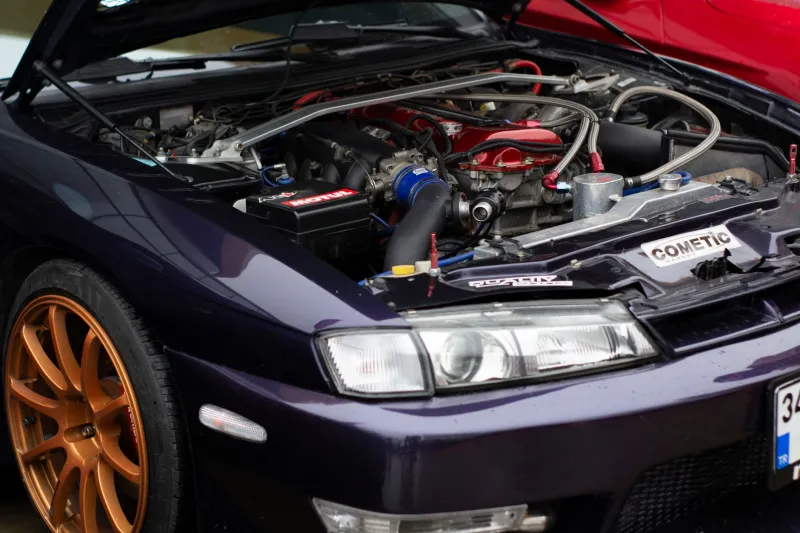
You spent months sourcing parts, dialing in your tune, and finally getting your turbocharged build to a place where it feels genuinely fast. You stop at the gas station, reach for the 93 octane handle like a responsible enthusiast, and drive away feeling good about yourself. Here's the uncomfortable truth: depending on how aggressive your setup is, that decision might be slowly working against everything you just built.
Premium fuel is not a universal solution for forced induction engines. It's a baseline. And for a lot of boosted builds running serious power levels, it's not even close to enough.
Why Forced Induction Changes the Fuel Equation Completely
Naturally aspirated engines and forced induction engines live in fundamentally different worlds when it comes to combustion. When you force compressed air into a cylinder — whether through a turbocharger or a supercharger — you're raising cylinder pressure dramatically. More pressure means more heat. More heat means the air-fuel mixture wants to ignite before the spark plug fires. That premature ignition is called detonation, or knock, and it is genuinely destructive.
A single knock event won't necessarily blow your engine. But repeated detonation at high boost levels will hammer your pistons, crack ring lands, and eventually turn your expensive forged internals into scrap metal. The scary part is that modern ECUs are good enough at pulling timing to mask knock from the driver — your car might be quietly protecting itself at the cost of power and long-term reliability, and you'd never know.
Octane is essentially a fuel's resistance to that premature ignition. Higher octane buys your engine more time to complete a controlled burn before pressure-induced detonation kicks off. For a stock-ish engine making modest boost, 93 octane usually does the job. But once you start pushing real boost pressure — say, anything north of 15-18 psi on a street tune — the margin gets thin fast.
RON vs. MON: The Rating System That's Confusing Everyone
Here's where it gets a little technical, but stick with it because this matters. When you see "93 octane" on an American pump, that number is an AKI rating — Anti-Knock Index — which is calculated as the average of two separate measurements: RON (Research Octane Number) and MON (Motor Octane Number).
RON measures knock resistance under relatively mild, low-speed test conditions. MON tests it under harsher, high-temperature, high-RPM conditions that are much closer to what a boosted engine actually experiences under load. European fuel ratings typically display RON only, which is why a "95 RON" fuel in Europe and "93 AKI" in the US aren't as far apart as they look — they're measuring different things.
The MON number is the one that really matters for your turbo build. And MON is almost always significantly lower than RON for any given fuel. That gap between RON and MON — called the sensitivity — tells you how much the fuel's knock resistance degrades under real-world heat and pressure. High-sensitivity fuels look great on the RON side of the equation but fall apart exactly when your boosted engine needs them most.
When your tuner talks about a fuel being "stable under load," they're really talking about a favorable RON-to-MON relationship. Most 93 AKI pump gas at your local station doesn't have that story.
What Actually Happens at the Pump Across the US
Another factor that doesn't get discussed enough is fuel quality variability. The 93 octane you pump in Florida in July is not the same as the 93 octane you pump in Colorado in January. Seasonal blends, ethanol content shifts, and regional refinery differences mean the octane rating on the pump is a legal minimum, not a guaranteed consistent product.
For a naturally aspirated weekend cruiser, that variability is mostly irrelevant. For a turbocharged car running an aggressive tune close to the edge of knock threshold, that same variability can be the difference between a great pull and a damaging one. Your tune was calibrated on a specific fuel. When the fuel changes, the tune doesn't automatically adjust — your knock sensors scramble to compensate, and you lose power and reliability in the process.
The E85 Conversation You've Been Avoiding
E85 — a blend of 85% ethanol and 15% gasoline — has become the go-to fuel for serious forced induction builds, and for good reason. Ethanol carries a RON of around 108-109 and a MON in the mid-90s. More importantly, ethanol has exceptional cooling properties. As it vaporizes in the intake tract, it pulls heat out of the incoming charge, which directly reduces the cylinder temperatures that cause detonation.
The practical result is that an E85 tune on a properly set-up forced induction engine can support significantly more boost and timing advance than a pump gas tune — often unlocking 15-25% more power from the same hardware. That's not a small number.
The trade-offs are real though. Ethanol is corrosive to older fuel system components, so rubber lines, stock injectors, and low-pressure fuel pumps may need upgrading. E85 also has lower energy density than gasoline, meaning your injectors need to flow roughly 30-40% more fuel to maintain the correct air-fuel ratio. You need bigger injectors, a higher-flow fuel pump, and a tune specifically written for ethanol. Do it half-heartedly and you'll run lean at the worst possible moment.
E85 availability also varies across the US. It's common across the Midwest — ethanol country — but patchier on the coasts. Apps like the Alternative Fuels Station Locator from the DOE can help you map out local availability before you commit to a flex-fuel setup.
Flex Fuel: The Best of Both Worlds for Street Builds
If you're running a street car that needs to survive on pump gas when E85 isn't available, a flex-fuel kit is the answer a lot of builders land on. A flex-fuel sensor reads the ethanol content of whatever you've pumped in and feeds that data to the ECU in real time. A flex-fuel capable tune then adjusts fueling, boost, and timing on the fly based on what's actually in the tank.
Fill up with 93 AKI and the car runs the conservative pump gas map. Find an E85 station and watch the tune open up automatically. It's a genuinely elegant solution for street-driven performance builds, and the cost of a flex-fuel kit — typically $300-600 for the sensor and wiring — is trivial compared to the power and safety margin you gain.
Don't Let Fuel Be the Thing That Ends Your Build
A lot of builders obsess over horsepower numbers, turbo sizing, and intercooler efficiency — and then treat fuel selection as an afterthought. That's backwards. Fuel is the foundation every other tuning decision gets built on. Get it wrong and none of the expensive hardware decisions matter.
If you're running forced induction at any serious power level, have an honest conversation with your tuner about what fuel your current tune actually requires, what your fuel system can support, and whether a flex-fuel setup makes sense for how you use the car. The answer might surprise you — and it'll almost certainly save you from an expensive engine rebuild down the road.